
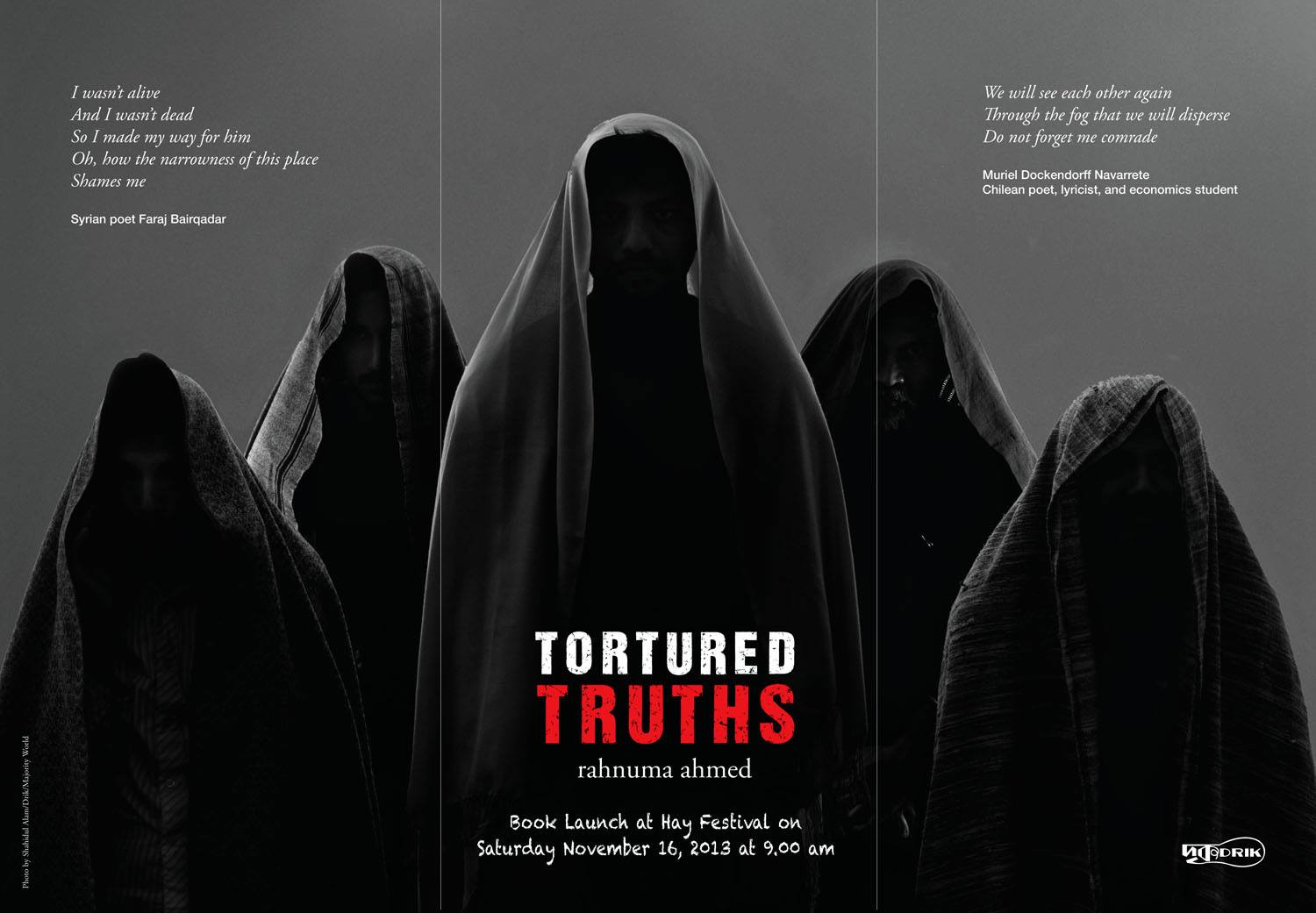
Tortured Truths by Rahnuma Ahmed
Publisher: Drik Books, Kartik 1420/November 2013
xxviii + 500 pages, with 139 illustrations. Hardcover
By Mahmudul Sumon
Tortured Truths is a collection of newspaper columns and a public lecture, written by Rahnuma Ahmed during the country’s most recent state of emergency (2007-2008), and after, writings which were published in the daily New Age.
The book is part of a larger project, a five-volume series of her New Age columns, the series title is “Exercising Freedom,” and the current volume is the first in the series. The forthcoming volumes are: Vol II, War on Terror’s Terrorisation; Vol III, Owning the Weather; Vol IV, Being a Woman, and Vol V, Death on the River Meghna. Published by Drik Books, the printing quality of Tortured Truths is good. Drik has had years of excellence in quality publication, mostly in the sector of photographic publications. In comparison, this book is text-heavy and the publisher has handled the demands of the author very well.
Tortured Truths is unlike other books where columns are just collated between two covers. The current volume is based on a particular theme and much of the pages of the book are a testament to that. The book contains a total of 56 pieces. The first set of 21 pieces is thematized under the rubric: “Writing under a State of Emergency” and the second set of 28 columns (with the one on the “consortium” government serialised in 7- parts) is under the rubric of “Election, and After.”
While she was working on her manuscript I asked Rahnuma why it was taking so long since the pieces had already been published, she had said that when they were being put together as a book, they had to be thought of as a new entity. An extensive use of images, a list of acronyms and a glossary are indications of the additional work done for the book. A very useful Preface is added to the volume where the author explains her work and position as far as her writings and politics are concerned. The use of endnotes for each article and a book index are important inclusions, and taken as a whole, I am sure these will greatly add to the value of the book, and make it an invaluable reference for future researchers.
The themes of the first set of essays written during the emergency period of the army-backed caretaker government is torture, state terror, masculinity, censorship, surveillance, extra-judicial killing and of course, Bangladesh and its people’s predicament. Taken as a whole, the essays are generally very reflexive, filled with searching questions. The topics are varied as they cover several years of continuous writing as a columnist. In my opinion, the essays written during the state of emergency are the most painful to read. In these writings, Ahmed focuses on a number of incidents of extra-judicial killing, torture at the hands of various law-enforcing agencies, and reminds us of what happened during the emergency period, and afterwards. In my opinion, her essay on the adivasi leader Choles Ritchil who died at the hands of the army during the emergency period and a number of other essays on torture, namely, “Tortured Truth”, “A Tortured image” and the consecutive ones on surveillance, namely, “Insecure at Last. The Age of Surveillance”, “ National ID Cards. In the Interest of Surveillance?” and “Again Surveillance. More on the National ID Card” are perhaps the very backbone of the book.
In broad sweeps, the pieces in this volume chronicle our time and space. They engage with the questions of how we are governed, the technologies with which we are governed, and our complicity in the process of governance. Rahnuma Ahmed argues that the caretaker government which ruled Bangladesh from January 2007 to December 2009 should be a called a “consortium” government instead of a “military-backed caretaker government” because it could not have come to power without the coming together of three separate entities, namely, the army, the civil society and the international community. These are “tortured truths” (the very title of the book) that many of us in Bangladesh have tried to shy away from, truths about which the privileged middle class prefers to stay tight-lipped and indifferent. Ahmed has different plans though. Through her writing, she provides chilling details of how people were picked up and blindfolded by the state’s security forces, how they were threatened and physically abused in the name of interrogation, how the ‘sirs’ commanded their subordinates, how people became severely ill, often permanently, after being tortured. In sum, she provides a narrative of how political vendetta is played out on the ordinary citizens of the country in recent times. And her focus is not only local but global, expressed rather pointedly when she writes “ …it is a global world, and we should learn from the African feminist who had said, I am oppressed not only by my patriarchal village headman, but equally so by the IMF and the World Bank” (p. 116). As for the issue of torture − which is the central concern of all the writings in this volume − I found these words worthy of serious reflection: ”Torture doesn’t bring out the truth. Torture victims have repeatedly said that after a certain point they admit to nearly anything” (p. 124).
It would be foolhardy on my part to try to discuss the full breadth of the topics discussed in the volume. As I have already mentioned, it is varied and covers a great range of issues which affect our lives. In the second set of essays, after the Awami League-led government came to power (December 2008), the themes of the essays change. More contemporary issues of governance by the party-in-power emerge. True, these are topics which have been discussed by other authors and commentators in Bangladesh (for instance, the Yunus saga, police brutality, the promulgation of hegemonic Bengali ethnicity by the state through the Fifteenth Amendment of the constitution, to name just a few), but Ahmed’s writing is different. Her texts are beautifully interwoven with social theory and contemporary scholarship, making it difficult for readers to ignore her arguments.
Essays in the second half include “Mirror, Mirror on the Wall, Who’s the Noblest of Them All?”, a take on the controversy over Professor Yunus. She is very right in pointing out that the present Awami League-led government’s criticism of Dr Yunus is not a principled one. She herself, is no Yunus-fan either, a position backed up by evidence provided by Lamia Karim’s research, where the latter demonstrates that Grameen Bank’s assertion that rural women are provided collateral-free microcredit, is a myth. In actuality, what is at stake is women’s “honour and shame” in rural Bangladesh “in the furtherance of capitalist goals.” Rahnuma ends her piece wittily: “Alfred Nobel’s fortune, bequeathed to those who benefit humanity through science, literature and efforts to promote peace, was made from the invention of dynamite. It is a product that is not known for having led to peace, either then, or now.”
The author is a staunch critic of neo-liberalisation and its execution in Bangladesh by its “leaders” (by this time a misnomer, I guess). She problematises the notion of modernity, more specifically, the Western modern project, which was local in some senses in the past, but has been universalised. She briefly alludes to this not only in the book’s preface but also in many other articles, such as, “You cannot eat coal: Resistance in Phulbari” where she draws on subaltern theorist Partha Chatterjee’s ideas, democracy is no longer “government of the people, by the people, and for the people” − clichés on which we have been brought up. Rahnuma writes, the “twentieth-century techniques of governing population groups, widespread acceptance of the idea of popular sovereignty, the creation of governmental bodies that administer populations but do not provide its citizens with arenas of democratic deliberations…give rise to democracy becoming a world of power” (p. 94), and uses this as a theoretical trope to note that the Phulbari voice of collective identity is framed within the politics of electoral democracy, best expressed in statements such as, “We have brought this government to power. How can they not do what we want?”, but to also go beyond the idea of democracy being a matter of electoral governance, through quoting a resident of Phulbari who asserts: [If they cannot do what we want then] We do not need any government (emphasis in the original).
This is a brave book. Some of the pieces flesh out the political economy of the armed forces in Bangladesh. Others reflect on “development,” an euphemism which the author would perhaps love to get rid of once and for all! In others, she protests against the violence committed on Limon Hossain, a young boy from Jhalakathi, who lost his leg because members of the Rapid Action Battallion (RAB) mistook him for a criminal. The first line of the Limon piece: “The problem with Limon – from RAB’s point of view – is that he has lived to tell the tale. Usually, RAB’s victims don’t” is a brave assertion in itself!
This book speaks “truth to power.” In her Preface, Rahnuma writes about how Nurul Kabir, the editor of New Age, who had become widely known and admired for his courage during the state of emergency, had invited her to write for the daily in end-2007. When she began writing, she had doubted whether her piece would get published. But New Age did publish them, and she recalls how Nurul Kabir had told her over the phone, “When you are writing, think that you are writing in the freest country in the world. Do not censor yourself…” (p. xviii ). After reading her writings in this volume, I think Rahnuma Ahmed has done exactly that. She has written freely and fearlessly. This book will go a long way in understanding Bangladesh’s recent political history. The onus is now on us, the readers, who need to embrace this beautiful piece of scholarship, so that, in the words of the author, we “no longer keep our eyes shut.”
—————————–
Mahmudul Sumon is Assistant Professor of Anthropology, Jahangirnagar University, Savar. This piece was first published in New Age Xtra November 29, 2013 issue.

Leave a comment