
Can anger ever be a memory? An Outsider’s Reflections on the strange second Liberation of Bangladesh
An Outsider (A guest blogger for Thotkata)
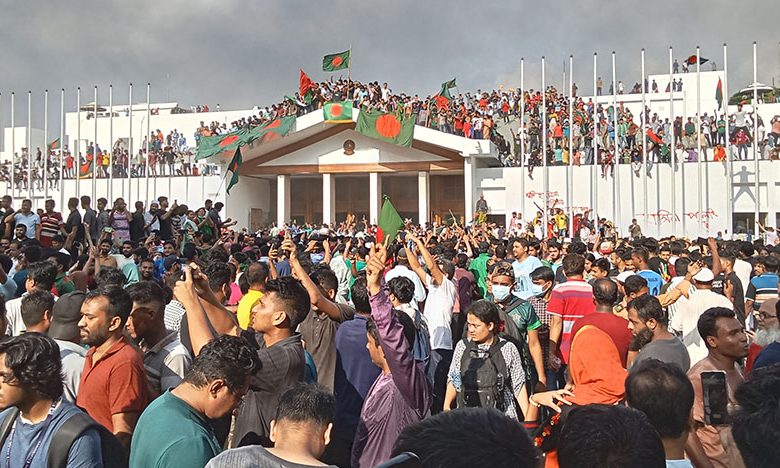
Public discourse in Bangladesh has the feel of a long-distance runner beginning to catch their breath after a marathon. What now?
“Survival is not transformation,” writes Hana Shams Ahmed in a forthright piece that shares with General Jaglul Ahmed a concern with Bangladesh’s structural problems that a largely peaceful election and transfer of power alone cannot resolve.
Ahmed is one of the most sure-footed commentators vocalizing the deep ambivalence towards the BNP victory among those who only voted for the party in the absence of a viable non-Islamist alternative. There is also foreboding that the BNP did not really win, and Jamaat did not really lose. Certainly Jamaat seems to have a level of confidence that is rare in political parties after an ostensibly crushing defeat.
The administration may in practice resemble the 2001 – 2006 coalition, perhaps proving to be a more commodious arrangement insofar as each party is free to blame the other in disavowing responsibility for governance failures to their respective constituencies. I suspect this will be a hall mark of BNP messaging as it copies from the Awami League playbook trying to hold its loveless, “patchwork” voting bloc together: “we are all that stands between you and the fundamentalists”.
A rough idea of spheres of influence is already discernible. The government will control the line ministries, and the cantonment and diplomatic zones where they will impress foreign buyers with Bangladesh’s moderate Muslim identity. Meanwhile Jamaat will become ever more assertive in shaping the national culture outside an ever more heavily policed set of checkpoints and barricades. Mirpur and Dhanmondhi, and rural areas inhabited by minorities, or near tourist spots will continue to comprise an intensifying liminal contact zone, where the contradictions reveal themselves in the news reports of women harassed, and claimed insults to community sentiment.
It is one of the most peculiar aspects of the whole affair. For years the expert analysts would pour cold water on the Awami League versus BNP – Jamaat dichotomy. At worst, we were told, this was regime propaganda. At best, it was an unsophisticated appraisal that failed to grasp the complex nuances understood only by the duly initiated.
And yet the old binary has reasserted itself with uncanny precision. An Awami League tyrant has been deposed by the military in response to popular discontent during a major economic downturn, prompting a deep reassessment of Bangladeshi identity. The turn towards Islamic if not Islamist referents has accompanied a foreign policy move towards Pakistan, China and the US, and a drastic cooling of the India relationship.
The unsettling parallels with 1974 were foreseen by some Bangladeshis, generally outside the Gulshan-Baridhara enclave, many years ago. As early as 2014, a close friend drew the comparison between Hasina and her father in the rise of the personality cult and the drastic curtailment of civil liberties. They predicted it would come to a similar end: “And then we get Jamaat.” The analysts will deny this of course, because it is difficult to justify lucrative consulting fees for knowledge that any villager who has passed class five possesses.
But I was told that the NCP were “fully Jamaat” months before the electoral alliance was announced, and by people who are not regular panelists at the Pan-Pacific Sonargaon.
The political discourse during the election remained one of cops and robbers, freedom fighters and razakars, but with the polarities reversed as the understudies replaced the evening cast.
I know the controversy surrounding President Shahabuddin’s revelations to Kaler Kantho, or the replacement of the governor of the Bank of Bangladesh are important, but I cannot honestly find in these episodes anything other than bathos. At worst they are a distraction from the only question that matters, and useful insofar as they might provide early indicators as to the answer: can the revolution be saved?
That there has as yet been no revolution is now broadly accepted.[1] Some say it was hijacked, but opinions differ as to when this occurred and who did the hijacking. The absence is felt every day in the practical experience of millions of Bangladeshis.
The revolution and national cohesion depend on reconciliation. While organizations like the Bangladesh Legal Aid Services Trust (BLAST) have been saying this for a while, it was a research team from the International Institute of Law and Development (IILD) and the Bangladesh 2.0 Initiative who most starkly addressed the risks posed by “political compromise and selective justice” to meaningful redress for victims. The great danger is that many would prefer selective justice to no justice at all.
Some Bangladeshis want justice so badly they tried to murder some of their own journalists last December, when they burned down the offices of the leading newspapers Prothom Alo and the Daily Star. Under the headline “The Uprisings in Bangladesh Will Not be Stopped”, Sajad Hameed and Rehan Qayoom Mir invited the readers of the Jacobin to empathize with these would-be murderers, for whom these newspapers were the “polished face of establishment consensus”.
This captures the dilemma perfectly. We now know that the attacks were orchestrated by provocateurs who depicted the journalists as “pro-India” or as the willing agents of the Indian government. They harnessed the anger at a status quo that the long July has left largely intact, directing it towards a useful scapegoat.
This is India as consolation prize. India is what the Bangladeshis can have, because they cannot have justice.
This is not about the threat the Bangladesh Army poses to India, although it bears restating that the answer is absolutely no threat whatsoever. Forget the disparity in numbers and equipment. Purely from a qualitative perspective, the post-Liberation War Bangladesh Army has demonstrated competence in two tasks: raping tribal women,[2] and playing golf. Army officers are apparently passable hoteliers, but the Radisson Blu is nothing special, even in comparison with the better resorts in Cox’s Bazaar.
Regarding the jobs you might expect an army to be good at, the picture is bleak. This is the outfit that turned up to the Rwandan genocide without soap (not a typo). The U.N. Commander Romeo Dallaire viewed them as “nearly useless”, lacking courage and professionalism, at times going as far as to sabotage their own vehicles to avoid following orders. The Washington Post’s international front page on the 20th April 1994 showed “Bangladeshi officers and NCOs – leaving their troops to wait for the next plane … rushing an evacuation aircraft like a scared herd of cattle.”[3]
More recently we have seen the security forces failing to ensure basic law and order, failing to catch political assassins at the border and failing to conduct a simple training flight without destroying a school (Radisson Blu patrons take note).
Rape and golf. With an annual budget of 40,000 crore, this is all the Bangladesh Armed Forces are good for. This is no disrespect to the brave pilot who did his best to avoid hitting the school, or the six peacekeepers killed recently in Sudan. Indeed, the disrespect has been to bury these people with full honors without an inquiry into whether, had their leaders spent less time running mediocre hotels and more time training soldiers to soldier, and aircrew to maintain aircraft, these dreadful incidents might have been avoided.
Finally, while my main interest here is the impunity the army has enjoyed so far for murdering the country’s children, it is worth noting in passing how ineffective a job it did. It takes nothing away from the horror of the massacres, or the sacrifice of the 1,400 protesters and their families, to make this basic observation.
In two weeks, Bangladesh’s security forces managed to murder significantly fewer unarmed children than lower bound estimates of what the Chinese did in a single day in and around Tiananmen Square on 4th June 1989.[4] This year, on 25th January, Time magazine reported that “as many as 30,000 people” might have been killed by Iran’s security forces on 8th and 9th of January alone, according to senior sources in the Iranian Health Ministry. Iran’s population is just over half that of Bangladesh.
The Indian army, whatever its faults, is not staffed by unarmed children. India will nonetheless be permitted to Bangladeshis as one channel for their anger at the impossibility of justice. Minorities are a second, Women are the third. They will be given to Bangladeshis the way napa paracetamol is the only medicine provided to tea garden workers, or daughters-in-law are the only thing offered to women, or African Americans were offered to poor whites in the slave-owning states of the old American Confederacy. Ambedkar situated gradation as the secret of casteism’s resilience, and this applies to any stable form of oppression. When even “the low is privileged as compared with lower … every class is interested in maintaining the system.”[5]
I am not excusing the Indian media’s own lapse into hysteria, or the arrogance and condescension of India’s government. I do not question the severity of Hasina’s crimes, or justify her current, astonishingly dangerous behaviour. India’s historical ties with Hasina personally and the Awami League institutionally nonetheless cannot completely explain the repeated refusal to extradite her.
Tonally, there is also something of the seasoned bar tender to these refusals; “I’m sorry, sir, but you’ve had enough.”
Because it won’t be enough.
Because the Indians can see, as clearly as anyone, that this is not about justice at all.
If this was about justice, or honoring the sacrifice of the martyrs, then the contribution of women to the July uprising would not have been systematically marginalized as a means of maintaining their political exclusion. The betrayal of the NCP, the party founded on the back of the student movement, is among the most bitter examples where, as Sushmita Preetha concludes in her masterful indictment of the current moment, “the men, generously, will take it from here. At least until the next uprising, when women will once again be urgently required.”
If it was about justice, then dozens, “perhaps even hundreds”, of communists, lawyers and bureaucrats would not have been arrested without evidence, sometimes without charge, accused of complicity with the Hasina regime. Nor would 266 journalists be facing murder charges on the basis that their journalism “incited” the killings during the protest movement.
If it was about justice, then the army and intelligence services would not have permitted five Directors-General of the DGFI and up to 187 police officers implicated in the repression to flee the country.
If this was about justice, Chief of the Army Staff Waker-Uz-Zaman would not remain free to work on his golf handicap at the taxpayers’ expense, nor would he have been awarded the Senabahini Padak medal by the Chief Advisor last November.
Hasina, we are told, was a fascist. But it is a strange kind of fascism where the leader does not control the army. It is a strange way to pay respect to those who fell during the long July by honoring the men who murdered them, or giving these men recognition for not killing as many children as they might otherwise have killed. The Nuremberg tribunals did not allow Herman Göring to retire on full pension. He was sentenced to death, as were most of the surviving high command of Nazi Germany’s military (Göring himself committed suicide in his jail cell). The head of the navy, Karl Dönitz, was sentenced to ten years imprisonment, the lightest sentence and yet still twice as long as that given to former Inspector General of Police, Chowdhury Abdullah Al-Mamun.
There was no handwringing in the German press in 1945 about how to reform the Gestapo secret police, or the Schutzstaffel (SS) paramilitary forces. They were abolished and their members criminalized. Instead of a secret police, Germany today has a domestic intelligence agency that is under judicial supervision and, like the UK’s Mi5, has investigative authority only, with no powers of arrest or detention.
Former army chief General Bhuiyan is probably the most prominent voice calling for the abolition of Bangladesh’s own paramilitary forces and Gestapo, the RAB and the DGFI, and yet it seems they will be retained intact. Certainly Nobel Peace Prize laureate Mohammed Yunus saw no reason to dispense with their services. Instead he demanded resources from rich countries to pay for loss and damage cause by climate change, while the Bangladeshi taxpayer continues to fund the loss and damage inflicted by the cadre of professional torturers that remain in the state’s employ.
These facts are sharply discordant with the mordant, ridiculous public offering of Hasanul Haque Inu to the ghosts of the long July. Similarly, the putative uniqueness of Hasina’s villainy grates every day against the relentless sameness of life in her absence. The jagged edges of all these inconsistencies have led to a furious contest over meaning. The most troubling examples are in agreement with our seasoned bar tender: even Hasina won’t be enough. Tyranny’s roots are much more deeply embedded, in the Awami League’s Bengali nationalism, in Hinduism and Tagore (India and minorities).
Ebadur Rahman provides a salutary example, when he argues for the dismantling of the “civilizational grammar … aesthetic sovereignty” and “curatorial apparatus” of Bangladesh’s foundational nationalism. This is as courageously oblique a defense of the destruction of the Chhayanaut cultural center and the harassment of Bangladesh’s university faculty as I have yet encountered.
A self-described decolonial cultural theorist and Buddhist scholar, Rahman is clearly well versed in Maududi. Consider Reza Nasr’s discussion of Maududi, and the culturalist emphasis of Jamaat e Islami: “The problem with imperialism, which in Mawdudi’s view had produced … the menace of Hinduism, was essentially cultural … It’s evil lay in the propagation of such moral and ethical evils as women’s emancipation, secularism, and nationalism, all of which ran contrary to the teachings of Islam … He worried less about economic liberation than about preserving dress, language and customs … safeguarding Muslim culture.”[6]
Pakistani military officers emphasized Hindu domination and Indian intrigue as the cause of the Awami League’s electoral success in 1970 that precipitated the crisis. This alibi for their gross repression is replicated without modification or apology by General Niazi in his self-serving and thin-skinned memoir published in 1998, where he denounces the “exploitation” of West Pakistanis by the “Hindu-controlled Bengalis”.[7]
But Rahman’s essay has weaknesses besides his (no doubt unintentional) plagiarism of Abul A’la al-Maududi and Lieutenant General Amir Abdullah Khan Niazi. His discussion of “dominant” secularism might leave you with the misleading impression, for example, that atheists and members of the LGBTQ community are hacking Muslims to death just for being Muslim, rather than the other way around.
In decrying the ways in which “dominant” secularism has rendered “other Bengali lifeworlds perpetually illegitimate”, Rahman erases completely the lifeworlds of non-Bengali Bangladeshis. This is an odd thing for a self-described Buddhist Scholar and decolonial cultural theorist to do. Perhaps, however unwittingly, he finds himself in agreement with the dread-fascist mastermind Mujib in believing the Adivasis to be “all Bengalis now”.
Mr Rahman is of course free to stomp on however many harmoniums as he likes, while virtuously torturing the writings of Edward Said to justify such vandalism as decolonial praxis. Even this will not suffice. “I’m sorry sir, but you’ve had enough.”
Because the anger will never be a memory.
Anger is complex. It is a response to an unmet expectation, to the world not being as it should be. It summons every neurochemical resource the brain can muster; serotonin, cortisol, dopamine, adrenaline. Anger does this to negate our sense of helplessness, or impotence, to give us the wherewithal to fight, to protect our sense of self, to ward off and avenge injury.
Anger creates an “open loop” in the brain. To close this loop, we need to feel that we are no longer in danger. In practical social terms this means that those who wronged us need to make amends, or else be put in a situation where they cannot do the same thing to us again. In extremely serious cases like murder, this typically means imprisonment. “Letting go” in the absence of this kind of resolution is extremely tough, and needs precisely the reworking of meaning in which Bangladesh public discourse is presently engaged.
I say “extremely tough”, but this is true when the memory of harm is distant, when our minds are permitted the salve of time to close the loop. Often additional measures, like therapy, are vitally important in this process. If the loop is not closed, if meaning is not reconfigured, anger is practically immortal, to be relived endlessly. Victims have spoken of exhaustion, according to the IILD report, “being asked repeatedly to recount their experiences in gatherings and programmes, which they found to be uncomfortable and re-traumatising.” I fear the victims will continue to be cynically used in this way as another means to distract us from the dreadful, remorseless continuity of a present permits no end to the anger.
Sometimes it seems we forget that the student-led uprising was about jobs. An earthier, more practical problem than liberty, but also a problem where it is much easier to agree what we are talking about. Jobs are more concrete than the abstract and subjective concept of freedom or, god forbid, the ability of a journalist to sit down at her desk without some earnest justice-seeker threatening to burn the building down around her.
In the current commentary the issue of jobs and employment often segues into economics but this is a partial truth. Ahmede Hussain and Debapriya Bhattacharya both introduce the awkward issue of human dignity into the discussion of youth underemployment. Social relations in the framework of Bangladeshi society and state are characterized by performative acts of domination and submission, ritual humiliation and sycophancy. Advocate Sultana Kamal has repeatedly stressed such Raja-praja dynamics as among the most important sources of Bangladesh’s ills, and this is probably paying a disservice to the Mughals and Nawabs.
A generation of lower middle-class young people were told that an education would bring them dignity and respect. Instead they found themselves unemployed, or employed under miserable working conditions. Treated like servants, told to consider themselves lucky, often facing significant delays in the payment of mediocre salaries, sometimes offered partially in-kind.
The mob as an institution holds revelations for those willing to look. It is the only means by which many Bangladeshis feel any sense of political agency or control over their own lives. Perhaps more importantly, it is a rare setting where people experience the feeling of equality. No scrimping and bowing or touching feet. No “ji sir ji sir.”
The mob in the abstract offers a dignity upheld in few Bangladeshi workplaces. As an added bonus, being part of the mob practically guarantees that you will not be burned to death, a privilege denied to garments sector workers and, since December, the media.
It was pointed out before the election that none of the parties recognized this, or had a strategy to change it.
The protesters took to the streets because the fifteen or so great families who own the country run it on the most exploitative terms that are practicable. Bangladesh is, in the words of Rehman Sobhan, “an elite-dominated deeply unjust society.” Investments in education, healthcare and infrastructure are woefully insufficient and workers’ rights are practically non-existent. Young people continue to sit in traffic for hours inhaling filthy air to attend poorly paid jobs where they are treated like praja. Hasina is gone yet these problems remain.
As for the horrors of the long July and the massacre of their comrades, the Bangladeshis would need to forget that the men who bear obvious and direct responsibility for the killings are alive, and free, and living more comfortable lives than most of their victims and their families.
But the Bangladeshis are not being allowed to forget. They are being instructed to remember. To remember and to be grateful.
They should be gratefulfor the restraint of the slaughter, which Professor Naomi Hossain attributes to the “rare qualities of the Bangladesh army”.
So few were butchered, and after the killings the butchers, in their decency, safeguarded democracy. It could have been much, much worse. Next time, it may be much, much worse.
It is better to choose to believe that the current allocation of accountability justly reflects the degree of guilt, that selective justice is better than none at all. Better to imagine it was Hasina herself, heading a column of octogenarian party functionaries, old communists, and bloodthirsty journalists, shooting students in the streets.
As Mahfuz Anam has drily observed, this would make Bangladesh an unlikely world leader when it comes to homicidal journalists.
To question the narrative is, however, a hazardous exercise, a point emphasized by Yunus’ Press Secretary, Shafiqul Alam. Upset with the press for reporting on human rights abuses, he noted that the media had “received very great freedom under the interim government”.
It might be important in a narrow legal sense to note that it is not clear if he was speaking in a personal capacity or on behalf of the government. Really it doesn’t matter. Mr Alam plainly does not understand that the press receives its very great freedom from the constitution of the Peoples’ Republic of Bangladesh.
It is not given to any government to sell such freedoms in exchange for adulation or flattery. That bn previous government has met this most basic of obligations is irrelevant.
This is not least because, of course, such freedoms were not received from anyone. They were taken, by force, from Tikka Khan and Niazi, and the Al-Shams and Al-Badr death squads, torn from the fingers of dead Punjabi riflemen.
They were won, for the people, by the mukti joddhas and no horror committed in their name will alter the fact.
The interim government was a steward only of those freedoms, and he plainly does not understand this.
In citing reports from the same police force that shot a sixteen year old girl in the head during the protests as definitive, Mr Alam’s stance was similar to all prior administrations, that it is the role of overmighty security services to keep civil society in check, rather than the other way around. No doubt Hasina would have approved.
Counting 1947 the Bangladeshis have liberated themselves three times. Seeing this servant of the people barracking the praja for their insolence and presumption, demanding gratitudefor refraining from media censorship and repression, I wonder if they counted themselves finally well served by their government?
And if they did not, whose fault is that? Hasina’s? If we put her to death tomorrow, will all the Shafiqul Alams in the country suddenly grow a sense of civic duty and service to the public? Will they finally abandon Raja-praja?
Two months after Shafiqul Alam made these remarks, the government he represented failed dreadfully to protect the media from the mobs who, in pursuit of justice, burned down the offices of the Daily Star and Prothom Alo. His government’s proposals for media regulation that were described by Transparency International Bangladesh as a “parting mockery” for tightening state control of the media.
At 9:30pm on Saturday 7th of February, military troops in full combat gear picked up 21 journalists from the offices of the news site Bangladesh Times, taking them to the Uttara camp to “discuss” a recent story that criticized the army.
It was a strange kind of very great freedom that journalists received under the interim government.
Even though the powerful continuities with the past have been recently highlighted with a commendable frankness by one of the leaders of the July uprising, Mahfuz Alam, it remains virtually impossible to venture such ideas publicly without facing accusations of being an apologist for Hasina and “fascism”. This brings us back to the disquiet attending the BNP victory, because the same is true for suggesting governments prior Hasina committed comparable crimes.
Prominent elements of the Bengali secular left have policed this worldview, notably in their disgraceful support to narratives following Hasina’s fall that violence against minorities was not really violence against minorities, or else Indian propaganda. Accordingly, the many Bangladeshi voices calling for an end to the trough of loot and patronage completely instead of simply reallocating access rights every decade or so, were shouted down. Tareque Rahman was much as Shahidul Alam described him, as a hero who fought autocracy.
I wonder if Shahidul vai (I assume this to be his preferred transliteration) truly understands the recklessness of this gamble. I suspect he does, hence his newfound enthusiasm for the Palestinian cause, a bespoke consolation prize just for the secular left. Does he understand the strange compliment he pays to the Israel Defence Forces, or the backhanded condescension to the Palestinians, by demonstrating by his actions his belief that the Gaza genocide is a simpler problem to solve than the ongoing military occupation of the Chittagong Hill Tracts?
And if, at the end, he finds himself holed up in the Drik gallery, defending the last harmonium in Bangladesh against those Buddhist scholars and decolonial cultural theorists come to uproot the last vestige of fascist Bengali nationalism, will he look back on his sojourns to the Mediterranean and still think them the best use of his time and energy? Will the Palestinians?
I hope someone has warned them, he fought for secularism once.
The gamble is reckless because it requires the new Prime Minister to exercise a practically superhuman feat of moral leadership. He must abandon the trope of Hasina’s fascism, which is the key ideological prop upon which the ongoing system of exploitation depends. He must concede that previous BNP administrations committed the same crimes, and that the pain of those victims is of equal weight and worth as his own.
His mother offers an example to him in facing the test. Her public rejection of a “politics of vengeance” in her final days was a noble valediction, whatever her own misdeeds. There is also the example of the Adivasis, so bitterly repaid for rescuing the Prime Minister’s father during the Liberation War. Having found the strength not to wish what was done to them on their worst enemy, they have gone as far as to vote for the party that rejected the 1997 Peace Accord.
For inspiration and example in this supreme test of statesmanship, he can look in the first instance to his own mother, who in her final days called for the rejection of a “politics of vengeance”. Whatever her own misdeeds, this was a remarkable and noble valediction, and an obvious rebuke to the present selective distribution of justice.
Secondly there are the Adivasis, who were so bitterly repaid for rescuing the Prime Minister’s father during the Liberation War. Having found the strength not to wish what was done to them on their worst enemy, they have gone as far as to vote for the party that rejected the 1997 Peace Accord.
As the long July wore on, a quotation from the Hill Tracts activist, Kalpana Chakma circulated on social media: “Everything that is experimented on the Hills will be implemented on the plainlands”. Kalpana was abducted by members of the Bangladesh Army on 12th June 1996 and is still missing. The vindication of her prophecy demands recognition of the dreadful constancy that stretches across the intervening decades to grip tightly hold of the present.
The Prime Minister has the generational opportunity to dismiss any meaningful difference between his own experience and Kalpana’s, except of course that he received far gentler treatment. To make this admission would be to place his trust in the people, rallying them to a confrontation with the country’s vested interests and the mastaan military that protects them. The Liberation War still retains a narrative power he can call on. It is likely the toughest element of Bangladesh’s “foundational nationalism” for the decolonial cultural theorists to uproot.
Jamaat’s Amir, Dr. Shafiqur Rahman, denies that the party took an operational role on the side of Pakistan. Effectively they were neutral, opposing Bangladesh’s independence on a point of principle. Even taking this at face value, it is a strange argument. Jamaat were not war criminals. They were merely traitors, and doubly so, to the Pakistan government they supported but refused to fight for, and the Bangladesh state-to-be that they rejected.
But if high minded treason is no crime against humanity, what of Ramesh Chandra Sen, an 85 year old man[8] dying without trial or conviction in the cold of a Dinajpur winter, on the floor of a jail cell? One of over 100 custodial deaths under the interim government, he was denied bail and access to medical care. Granted he was an Awami League minister and member of its Presidium, but if his death was justice then why kill him the way Hasina killed Mushtaq Ahmed? If Hasina was evil then why did the Interim Government flatter her so in this fastidious imitation of her methods? And why did so few speak against it?
Was such an end what Mr Sen might have imagined when he was seven years old, a witness to the August midnight of 1947. He must have celebrated his 31st birthday a little more than a month after the launch of Operation Searchlight; a fortnight before the Mukti Bahinibegan one of the most successful guerilla campaigns waged by any army in the world, which triumphantly strangled Niazi’s Eastern Command to death.
While Jamaat-e-Islami were honorably betraying everyone by piously absenting themselves from the battlefield, the minorities and Indigenous Peoples were well represented on the frontlines against Niazi, as were women. Two women were awarded the Bir Protik medal for gallantry in wartime, one of them from the Khasi Indigenous community.
The best the Chief of the Army Staff can do is the Senabahini Padakgifted to him by Yunus last year. But then, unlike these women, the Chief of the Army Staff has never fought in a war.
And yes, the Mukti Bahinidid this with India’s support. India, minorities, and women. All those now potentially offered as consolation prizes, instead of justice.
In one of his last public interventions, Professor Anisuzzaman ruefully recalled how the founding Planning Commission envisaged a country where “… the talents of every citizen would be nurtured by the state.” Such a vision is still in reach, wedded to the long July via the 1990 restoration of democracy by a common desire for dignity.
The weight of the Prime Minister’s test, the test of true reconciliation, would be heavy burden for even the very strongest. This is before we consider the sweeping and foolhardy commitments made by the outgoing chief advisor to a super-power whose growing madness darkens the world a little bit more every day.
What if his strength fails him, and he follows the seductive, easy path urged on him by the partisans of Pinaki Bhattacharya, and throws the Bangladeshis their consolation prizes? Who benefits if he gives them India?
Modi does. Modi benefits. The BJP will be delighted with a vocally antagonistic government in Dhaka, ideally as Islamist and pro-Pakistan as possible. It may be the thing that finally secures for the BJP the Chief Ministership of West Bengal. Secondly, this failure will secure the system of graft and patronage, and the army that protects it, for another generation at least. Bangladeshis will never be able to hold their government accountable for anything ever again. All failures can henceforth be laid at New Delhi’s door. This might prove to be a very stable arrangement, two opposing religious fundamentalisms, glowering at each other across the Gangeatic plain, just as the BNP and Jamaat glower at each other across the Parliament chamber, implacable foes and the best of friends, each useful to the purposes of the other.
Meanwhile the Bangladeshis will continue crowding on to the battered buses, breathing filthy air in the interminable traffic. They will be allowed as much anger as they wish, as long as it is directed at the permitted targets. They needn’t worry, they will be clearly told what these targets are as they are guided carefully through a house of mirrors, a nation-wide Aynaghor filled with traitors within and enemies without. They will have all the razakars they could ever want.
The anger will never be a memory and whether, in the absence of justice, this will be better or worse than having nothing at all, who can say? One thing is certain. The roots of this rage will not lie in Tagore, or Bengali nationalism, or the Hindus. It won’t be the feminists or the LGBTQ community, or the secularists or the Adivasis.
The well-spring of this anger will be the daily, public demand that the Bangladeshis remain grateful to their murderers and their exploiters.
It will be a strange kind of liberation.
In the absence of transformation, it will be a strange kind of survival.
Strange. And full of dread.
Authors’ Note: I am using a pseudonym because I am terrified of the mobs of secularists and murderous journalists.
Additional Authors’ Note: I am obviously joking. It’s the Gestapo. I’m using a pseudonym because there. is. still. a. motherfucking Gestapo y’all.
[1] Safieh Kabir, Azfar Shafi and Saif Kazi. 2025. Inquilab Zindabad. A socialist analysis of Bangladesh after the uprisings. London: Nijjor Manush.
[2] D’Costa, Bina. 2014. Marginalization and Impunity: Violence Against Women and Girls in the Chittagong Hill Tracts. Dhaka: Chittagong Hill Tracts Commission.
[3] Roméo Dallaire. 2003. Shake Hands with the Devil: the Failure of Humanity In Rwanda. New York: Carroll and Graf. See “frustrations with” and “poorly equipped” under the “Bangladeshi troops” heading in the Index for a full list of relevant references.
[4] A declassified diplomatic cable to the British government from their ambassador relays a figure of 10,000, from a source within China’s State Council. The Beijing Red Cross’ estimate at the time was 2,600 protesters killed. Andrew J. Nathan and Perry Link (eds). 2001. The Tiananmen Papers. London: Abacus. 507.
[5] Dr Babasaheb Ambedkar. 2014. Writings and Speeches, vol. 5. Dr Ambedkar Foundation: New Delhi. 102.
[6] Seyyed Vali Reza Nasr. 1996. Mawdudi and the making of Islamic Revivalism. Oxford: Oxford University Press. 49 -50.
[7] A.A.K. Niazi. 1998. The Betrayal of East Pakistan. New Delhi: Manohar. 34.
[8] Different media outlets give conflicting reports of Mr Sen’s age. The Dhaka Tribune gives his full date of birth as 30th April 1940, consistent with the Wikipedia entry.

Leave a comment